
BEHIND THE WORDS
Nora D’Ecclesis, Interview Host
featuring guest Tissa Richards
Author of
Rethinking Resilience: Fueling Your Competitive Advantage
Nora D’Ecclesis Host ~ Can moving away from old ways that don’t work be taught in a lecture, or does your book help to act as a catalyst for that change? The comprehensive look at Intentional Resilience and your concept of cadence as a practice is presented in your book to avoid misfires. Please tell us more about this.
Tissa Richards Author ~ A keynote can create awareness and excitement, and I deliver high-energy, high-ROI keynotes regularly on this topic. But real change requires practice. Rethinking Resilience is designed to be a catalyst, not just a moment of inspiration. It helps leaders recognize where the old “power through and bounce back” model of reactive resilience misfires, then gives them a repeatable way to shift to Intentional Resilience and respond differently. Cadence matters because insight without rhythm doesn’t stick. Intentional Resilience only becomes useful when it moves from something you admire in theory to something you practice under pressure so regularly that it becomes muscle memory.
Nora ~ The core of the book revolves around the key elements of conviction, curiosity, clarity, communication, cadence, and capabilities. Do you craft your presentations and lectures, including all of these elements, in your flywheel or individually? Do you supplement with additional explanations, or do you proceed for the most part from the Q&A during lectures?
Tissa ~ Both – intentionally. I introduce the full Intentional Resilience Flywheel so people understand the system, then go deep on the one or two elements most relevant to that audience. For example: conviction for leaders stuck in indecision, cadence for teams burning out, clarity when complexity is the real problem. From there, we apply the framework to real-world scenarios teams are actively facing, mapping specific flywheel elements to areas of friction so we can remove them and see results immediately. The most valuable learning happens when people pressure-test the framework against their real situations and see real-world results.
Nora ~ What is the future of A.I. and nonfiction writing? We are all fascinated with the many uses for artificial intelligence and enjoy learning as much as possible.
Tissa ~ AI is a tool, not a replacement for an author’s insights and voice. It can accelerate research, help to structure your thinking, and improve clarity – but it can’t replace human judgment, lived experience, or conviction. The best nonfiction will be human-led and AI-assisted. Readers can tell the difference.
Nora ~ What are the lessons from your writing journey? What have you learned from helping others with your expertise, specifically from writing this book? Will there be a third book?
Tissa ~ This book reinforced a simple lesson for me as an author: write what you know, write what you care about, and write what can make a material difference. What surprised me most was just how hungry leaders are for validation that they’re not alone in what they are experiencing. Burnout, overload, and the need for a more effective model of practical resilience are shared challenges. The response from readers has confirmed how powerful it is to offer a pragmatic framework for Intentional Resilience that leaders can use immediately and see clear benefits from.
Nora ~ What is the one key element that sets this book apart from your competition?
Tissa ~ Rethinking Resilience fundamentally reimagines what resilience is for modern leaders. Instead of framing it as powering through or bouncing back after setbacks, the book positions Intentional Resilience as readiness, cultivating steadiness, clarity, and sustained energy so leaders can respond skillfully to disruption and also to opportunity. In practice, this shift delivers measurable ROI at the individual, team, and organizational levels: better decisions, reduced friction, stronger execution, and less burnout. What has been most meaningful to hear is that readers aren’t just leading differently, they’re living differently, with more presence, balance, and confidence.
Nora ~ How do you stay current in your field?
Tissa ~ I stay close to the work and to people. I advise senior leaders to sit at real boardroom tables as a board director and work closely with senior leadership teams on the ground. I watch what actually breaks under pressure and see the real benefits when pressure transforms into power. Trends matter less than patterns. Reality is the best research.
Nora ~ What is your favorite meal after a long writing session?
Tissa ~ I don’t refuel with food, I refuel with movement. A run, lifting weights, Pilates, or getting outside to walk my dog resets my nervous system and balances the mental load. That’s part of Intentional Resilience, too.
Nora ~ Do we learn from our mistakes or just continue mindlessly repeating the patterns?
Tissa ~ Most people repeat patterns until something forces awareness. Effective learning requires that we pause, reflect, and make intentional choices. Without those, experience just becomes repetition with better excuses – and no growth.
Nora ~ Compare intentional resilience and equanimity. Can equanimity strengthen resilience?
Tissa ~ Equanimity is emotional and mental steadiness. Intentional Resilience can be observed in action through operational steadiness. Equanimity helps you stay centered; Intentional Resilience helps you make optimal decisions and actions from that place of readiness and steadiness. Yes –equanimity strengthens Intentional Resilience, but only when it’s paired with action, not detachment.
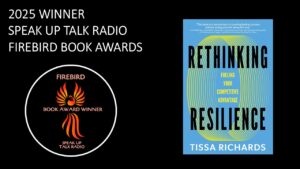
Nora ~ How did you feel about winning the Grand Prize for Non-Fiction Firebird Book Award, and how does such an award help your book?
Tissa ~ Grateful, and validated. Winning the Grand Prize signals that this message about Intentional Resilience resonates beyond a single audience. It gives the book credibility, reach, and momentum. The real value is when readers tell me it has changed how they lead and live. That’s a true goosebumps moment!