
Written Literary Conversations with Nora D’Ecclesis
Featuring Valerie Biel
Haven
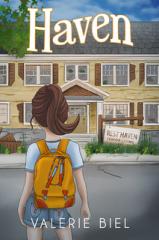
Nora D’Ecclesis: Val, please tell us how you describe Haven’s ideal reader? Will the middle school age be the primary reader, or can it also be for even younger children?
Valerie Biel: This book is written for grade four and up in terms of the reading level. Tackling the tough topic of domestic abuse for this age group was tricky, but the subject is treated as sensitively as possible as we view the story through the eyes of the 11-year-old protagonist. Ideally, this is a terrific book for a shared reading experience with a child and adult or in a classroom setting. The curriculum materials created for the book are for grades 4 – 6.
Additionally, in children’s literature in particular, I like to talk about windows and mirrors. We can’t underestimate the power literature has to build empathy for others when a story opens a window to a situation, theme, or topic that the reader has no experience with. Seeing a situation outside one’s own world experience, helps the reader to understand others and care for people in an empathetic manner. And perhaps even more important is when literature reflects back to us our own life situation not unlike a mirror, validating, recognizing, and truly seeing the world the reader is navigating.
Nora: Which scene in the book was the hardest to write? Please explain your writing and editing process for this scene.
Val: Without a doubt, the confrontation scene with the abusive father/husband was the toughest. To make it realistic without making it too scary for the age group required finesse and substantial rewriting. I’m actually unsure at this point how many times that scene was edited. My first attempts were more vague with fewer details. But in the end, I had to remind myself of the intelligence of the middle-grade reader and that creating a watered-down version of this scene’s very real danger was ultimately doing them and the story a disservice. With that said, I did consult with a children’s mental health therapist on the entire story to strike the right balance for the age of the intended reader.
Nora: What was the catalyst for the amazing chapter titles? I so enjoyed all of them, but Angry Red, Wild Blue Yonder, and Frosty Lavender caused me to smile, then pause and ponder.
Valerie: I’d like to say that it was a very specific thing, but it truly was a mash-up of ideas and inspiration. I love titled chapters, particularly in writing for this age group. I enjoy the title’s foreshadowing of some aspect of what’s to come. Color also represents a journey for the characters in this book. I wanted to show emotion through these color choices, and I feel that’s something we can all understand. . . how some colors are gloomy, or others are hopeful. One of my children has a type of synesthesia, where numbers are always seen as a certain color, and then that color evokes a certain emotion. Like the number four is blue and that is a happy color. I find this fascinating. The book A Mango-Shaped Space by Wendy Maas is a fabulous read on the topic. I also read The Secret Lives of Color by Kassia St. Clair, which talks a lot about the history of certain colors through the ages and more.
Nora: Mardella, as a young preteen, deals with guilt, fear, and some shame related to her nuclear family, which includes Mom Louisa and Dad Martin. How does she function with the anxiety that those emotions produce, and then resolve it?
Val: Mardella, initially, holds all these emotions internally—which is not healthy. She is sure that her actions dialing 911 caused all the trouble she and her mom, and even her dad, are experiencing. But in reality, it’s the adults in her life that have made the mistakes. She is, of course, fearful of her often-violent father and that fear extends to other people if they unintentionally act even remotely like her father has acted. She feels guilt that her mom had to find a new job at a Senior Living Center and they had to move so far away from home to be safe. And she feels shame that her family isn’t like other people’s families.
She’s sure no one can truly understand her life until she begins opening up to her new friends, both young and old, and finds that they don’t judge her for her actions or her family’s situation or the fact that her father isn’t a nice person. Although it’s not until the very end of the book that there’s resolution of these emotions (at least in part), when she and her mom talk openly about how Mardella should never have been carrying this emotional burden.
Nora: The mother, Louisa, seems to use denial, inadvertently, as a defense mechanism, hoping that things will change. She also believes in prayer. Is that common in the type of domestic abuse you are exploring in Haven?
Val: In my experience, people who are in a domestic abuse situation often hope that they can get the abuser to change or get better or return to the person/personality that they once were earlier in the relationship. This hopeful thinking is almost always detrimental, putting those suffering the abuse in a position to suffer even more abuse. The idea that we can ‘fix’ other people if we just love them more or do more or ARE more is a false kind of hope. Until someone wants to change their harmful patterns themself—whether that’s drug abuse or violent behavior—no amount of outside pressure or care will make a difference.
People in abusive relationships often take on the blame for the situation with “if only” thinking. “If only I hadn’t done this, he wouldn’t have been so mad.” For the victim, it’s a mental health rollercoaster that takes time to unravel. It’s not done overnight. But hopefully that offers some insight into the question of why people stay in abusive relationships. I feel Louisa’s prayerful pauses achieve two things for the story—showing that she is seeking a higher power to give her strength in a difficult time. Her life is out of control, so she’s seeking comfort in a practice that brings her a modicum of peace. But the praying also triggers Mardella’s extreme embarrassment that’s typical of an eleven year old as people notice and comment on it. Middle-school aged kids just want to fit in, and there’s so much about Mardella’s life that makes her stick out—and not in a good way.
Nora: What is the most valuable piece of advice you offer new authors as a consultant and guest lecturer?
Val: The story you have inside of you matters. Your unique voice has value. Never let anyone tell you otherwise. The world needs to hear what you have to say, whether that’s through fictional stories, nonfiction or essays or other creative endeavors like music or art.
Nora: Did placing Mardella as an eleven-year-old who helps her mother, Louisa Houston, bridge the perceived gap between older generational Boomers and generational Alpha cohorts?
Val: Oh, I love this question. I find that there’s quite a gap between younger people and older generations. Many kids don’t have grandparents in their lives, so ‘old’ people seem strange to them as they have no experience to draw from. (Even Mardella initially thinks Rest Haven Senior Living Center smells funny and is wary of its older residents.) One of my favorite parts of this book to write was the forging of intergenerational friendships and found family, ultimately showing that friendships can be made between people of all ages.
Nora: Why did you start writing and publishing your work and who is the biggest supporter in your life as an author?
Val: To be very honest, I decided to begin writing the fictional stories stuck in my head after my second sister was diagnosed with the same terminal cancer my eldest sister passed away from. It was a wake-up call to the fact that we don’t have forever on this earth. It shifted something inside of me to drop the things I was doing that weren’t bringing me satisfaction and finally fulfill my desire to write. If there’s one thing that came out of an incredibly sad situation, it was that I didn’t slog along in a career that wasn’t bringing me joy for years before making this leap.
My mom is probably my biggest supporter. I’m grateful she’s still around at age 88. She’s always asking how it’s going. My husband and children are also very big supporters. But financially, my husband is the one who made this all possible. The fact that we had an income through his career that gave me the freedom to pursue my dream cannot be emphasized enough. I’m forever grateful.